Introducing a new identity system to 3B+ users
Key skills involved: Content strategy, Localization, UXR, Accessibility, upsells on Instagram and Facebook
Overview and challenges
Phone numbers on WhatsApp are an essential part of the app. People use it to sign up for an account, connect with others and determine if an account is a real person/business or a scammer in disguise.Users on the consumer app wanted a way to prevent sharing their phone number with strangers in many contexts in the app including in large groups. Increased spam, unwanted messages and privacy risks for users meant a lower privacy sentiment toward the company.For small business owners, however phone number visibility is crucial. They want to display their phone number so that customers can easily reach them. The username is an additional identifier that helps their business identity.Username reservations launched on both consumer and business apps in June 2026, with full feature functionality launching by end of year.
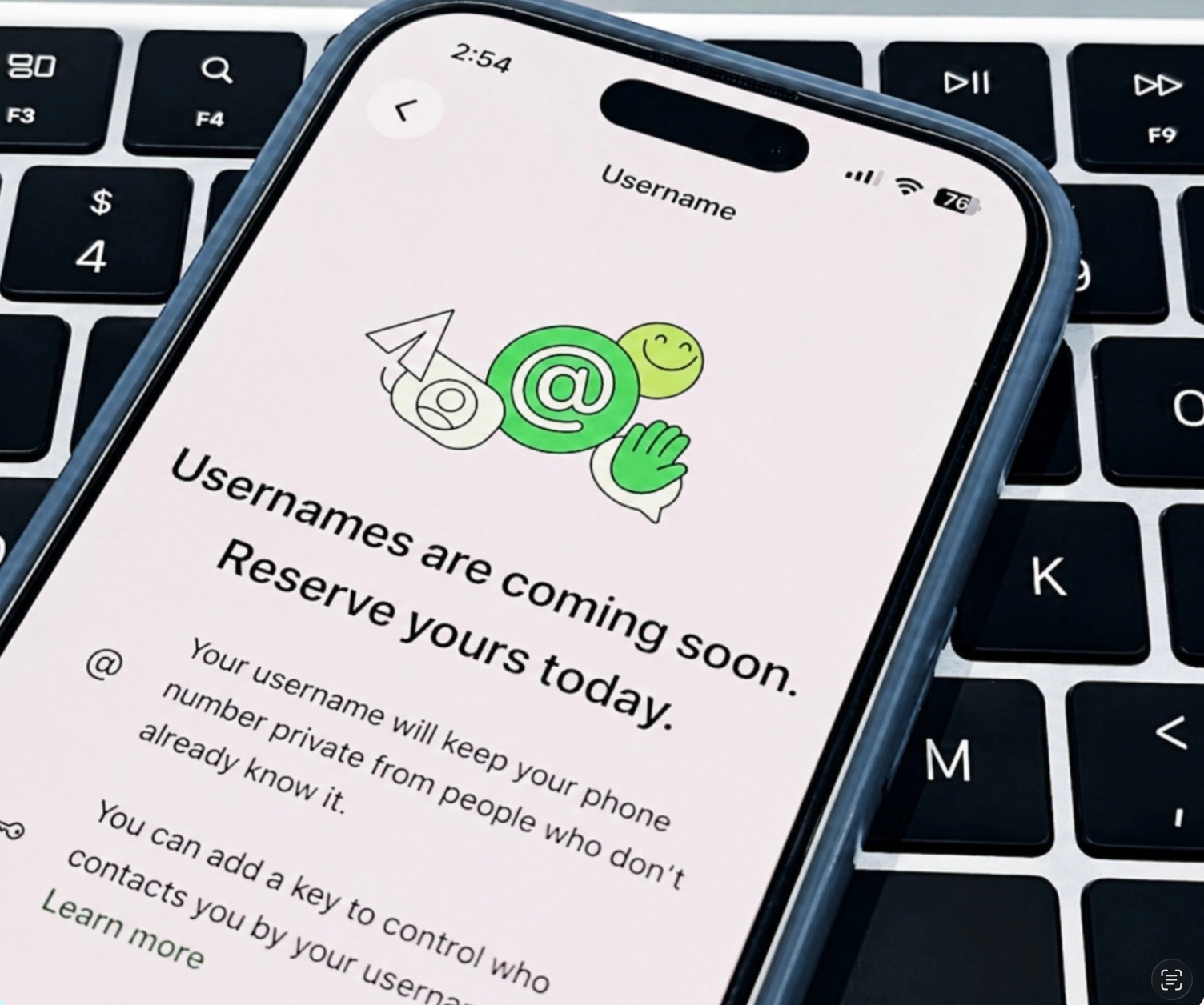
Case study: Consumer versus small business (SMB) app positioning
What: Identifying the needs of each audience to create appropriate value props and end-to-end flows.
Goals: Keep the 2 app flows as similar as possible but diverge when needed on messaging and positioning the feature.
Challenge and scope
How Might We… message the same underlying feature — usernames — in a way that speaks to privacy for consumers, and reach and discoverability for business owners, without the two experiences feeling disconnected?
Usernames came to both the consumer and SMB apps in June 2026. I had worked on the consumer app for about three years. As the lead content designer on usernames across WhatsApp, I needed to understand the business audience too, and how to position usernames to them versus what I knew of consumers. The flows would feel similar in structure, but needed to diverge sharply in messaging, based on what each audience actually needs.
Differing audience needs
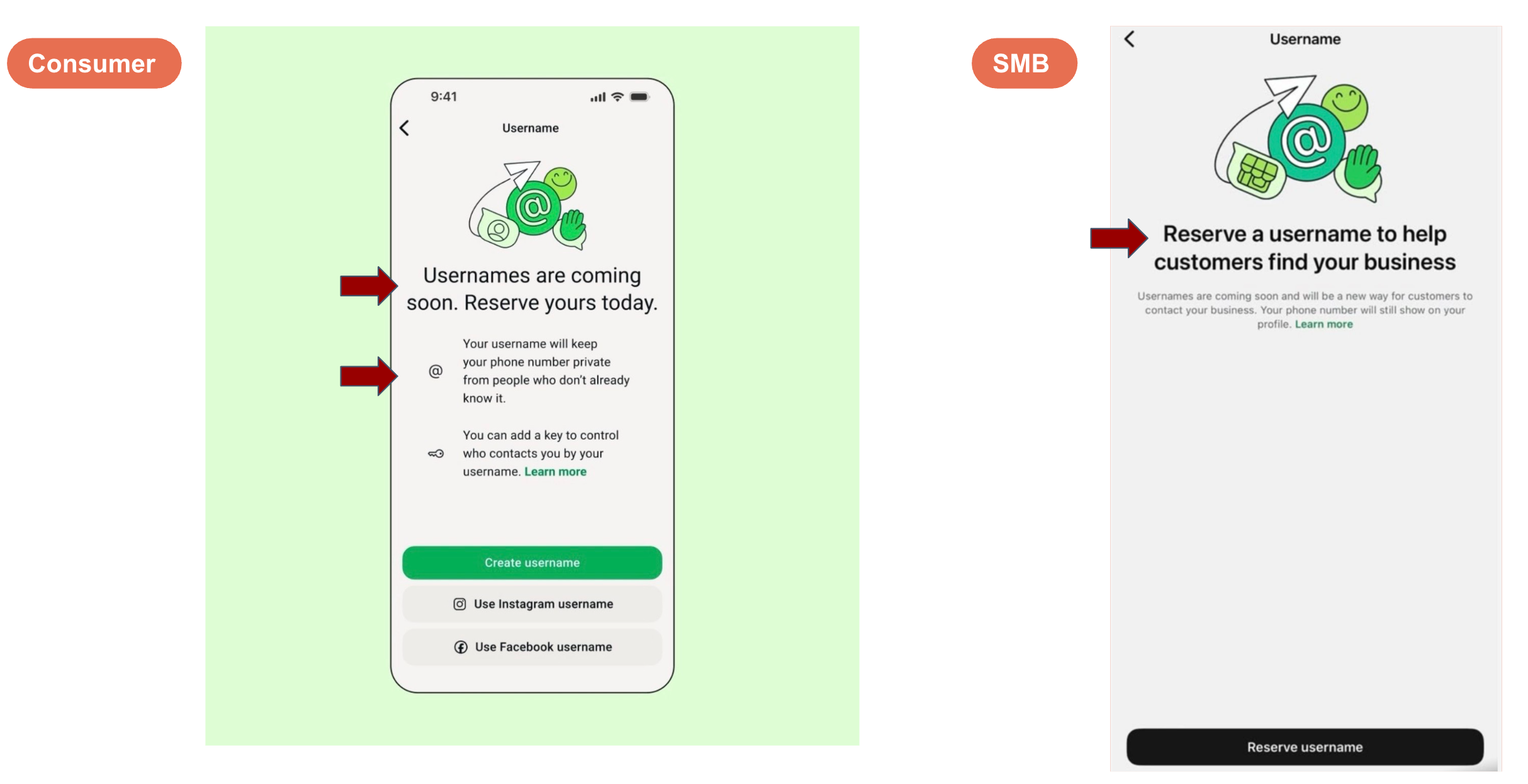
Primary value props for consumer and SMB apps
Usernames do a different job depending on who’s using them. Here’s what the research told me, and the insight I took from it:
Consumers — care primarily about keeping their phone number private. A username lets people see a username instead of their number.
Insight: Consumers want a key option to reduce unwanted messages from strangers or people they haven’t interacted with yet.SMB owners — appreciate the ease of memorizing and searching a business name that comes with usernames, and intend to use a username consistent with their business name on other platforms. They care about discoverability and reachability, not privacy, and their phone number still shows on their business profile.
Insight: A business owner would not want a key, since it limits reach. Customers use the phone number to evaluate legitimacy, so it should stay visible.
Strategy and process
As the lead content designer on usernames, I dug into what business owners need, checked my insights with the people closest to the SMB product, and aligned leads on one direction before moving on to the actual flows.
SMB research — Deep dive into the SMB audience and existing UXR. The core finding: for businesses, usernames are an enabler for discoverability and representation, taking precedence over privacy needs.
Partner check-ins — Talked with product and content designers on the SMB app to ask questions, validate my insights, and understand language nuances. It was a global team, with content designers in London.
Working principles — Defined principles based on UXR to guide the work (below).
Direction and alignment — Designed and distinguished the value prop directions for SMB, then brought my recommendation to the WhatsApp Content Director and SMB leads to align on the approach.
“For businesses, usernames are an enabler for discoverability and representation — taking precedence over privacy needs.” — SMB research finding
“We have practically 70 lines overall, all linked to WhatsApp from the commercial sector… there’s the caption — I put the name of the company and the salesperson.” — Business user, Brazil, P2
Working principles
Enable reach, limit friction. Customers should be able to easily reach a business that adopts a username. We need to make it as easy as possible to connect.
Don’t break migration. 25% of daily registrations move from the consumer to the business app, and privacy settings and the username carry over. I recommended we design this flow so users can edit this info later.
Maintain trust signals. Any change to business identity should be communicated clearly. Phone numbers remain an important trust signal and are always visible on the business profile. I recommended communicating this clearly, up front.
Tweak messaging for the SMB app, but keep the overall experience similar. Divergence from the consumer experience is expected, and SMBs get their own defaults, but I intentionally kept things similar where I could so it all feels like one product.
Value props tested and vetted
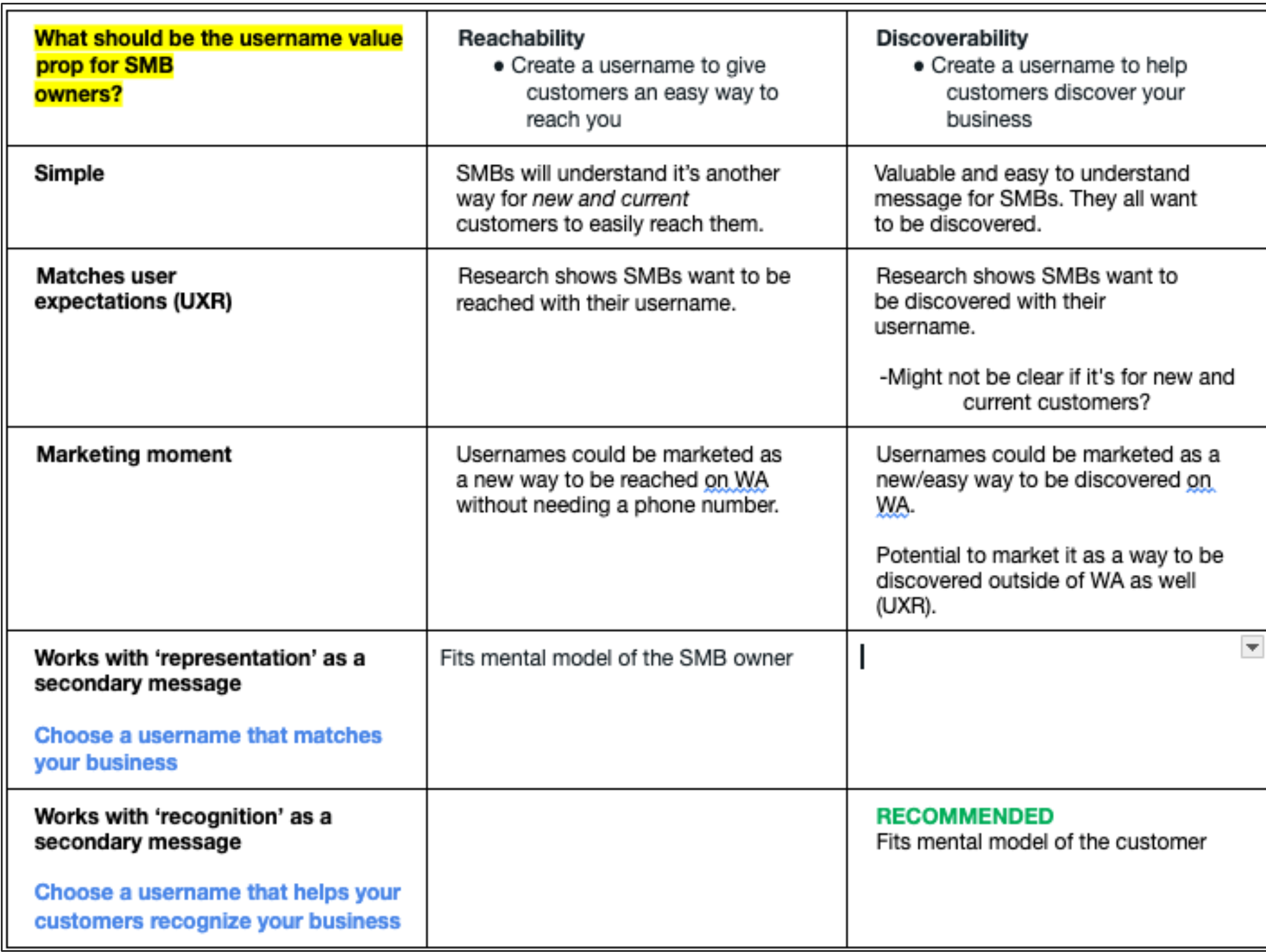
I compared two contenders against four criteria: is it simple, does it match user expectations (UXR), what is the marketing moment, and which secondary message does it pair with?
Reachability
“Create a username to give customers an easy way to reach you”
Pros: Simple — it reads as “another way to be reached.” Research backed it. It could be marketed as a new way to be reached without sharing a phone number. It pairs naturally with Representation (“Choose a username that matches your business”), which fits the SMB owner’s own mental model of their business.
Cons: Smaller upside. Its marketing story stays inside WhatsApp.
Discoverability
“Create a username to help customers discover your business”
Pros: Simple — it reads as “a way to be found.” Research backed it. It had a bigger marketing upside: it could extend beyond WhatsApp and position usernames as a discovery tool across a business’s broader presence. It pairs naturally with Recognition (“Choose a username that helps your customers recognize your business”), which fits the customer’s mental model.
Cons: It wasn’t always clear whether the message applied to new customers, current customers, or both.
Making a recommendation
Recommendation: Discoverability + Recognition
Primary message: “Create a username to help customers find your business”
Secondary message: “Choose a username that helps your customers recognize your business”
The deciding factor was whose mental model the message should center. The whole point of a username is to help customers find and recognize a business, so anchoring the secondary message to the customer’s perspective (Recognition) made more sense than the business owner’s view of themselves (Representation). That alignment with both UXR and the customer-first mental model made it the stronger pairing, and it best matched what SMB research surfaced: discoverability and representation, not privacy, are what businesses want from a username.
Two apps, two value props
The flows feel similar in structure, but each app leads with the job usernames does for that audience.
Consumer app: “Create a username for phone number privacy” — people who have your number will continue to see it.
SMB app: “Create a username to help customers find your business” — your phone number will still show on your profile.